
How to Sell an Online Course in 2026: A Step-by-Step Plan That Works
This guide walks you through every stage of building and selling an online course, with practical steps you can act on this week.
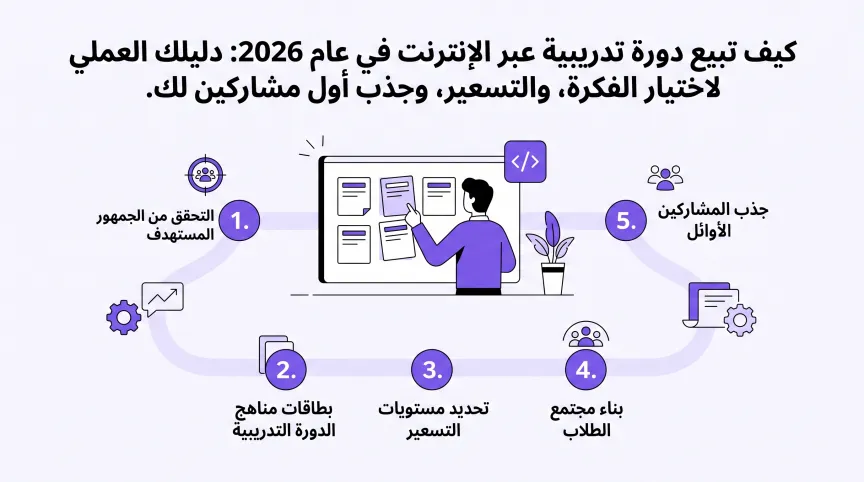
Short answer
Step 1: Choose a Course Topic That People Will Pay For
Your course should sit at the intersection of three things: what you know deeply, what a specific audience needs, and what people are already spending money on. The mistake most first-time course creators make is starting with what they want to teach rather than what learners want to learn.
Start by listing your professional skills, the questions people ask you repeatedly, and the problems you have solved in your career. Then cross-reference that list with real market signals. Use Google Trends to check whether interest in your topic is growing or declining. Search for your topic on platforms like Udemy, Coursera, and TRAIVIS to see how many existing courses exist and what reviewers say they wish those courses covered better.
Top-selling online courses in 2026 tend to focus on technology skills like coding and data analysis, business skills like digital marketing and project management, and personal growth areas like productivity and wellness. But niche topics often outperform broad ones because the competition is lower and the buyer intent is much stronger.
Step 2: Validate Demand Before You Build Anything
This is the step most course creators skip entirely, and it is the reason most courses fail to sell. Validation means confirming that real people will pay real money for what you plan to teach — before you invest weeks or months recording content.
Here is a simple validation process. First, identify five to ten long-tail keywords your potential buyer would search. Long-tail keywords like "how to build a WordPress site from scratch" convert far better than broad terms like "WordPress" because the search intent behind them is much stronger. Second, create a simple landing page describing your course concept, the key outcomes, and a signup form for early access. Third, share it with your existing audience — your email list, social media followers, or professional network. If you can collect fifty or more signups in two weeks, you have validated demand. If the response is weak, adjust the topic or angle before building.
Step 3: Build a Course That Delivers Real Results
A course that sells well is a course that gets results for students — because results lead to testimonials, referrals, and repeat purchases. Structure matters more than production value.
Structure Your Curriculum for Completion
Break your course into four to eight focused modules, each tackling one specific skill or concept. Within each module, create short lessons of five to fifteen minutes. Research consistently shows that shorter, focused videos have dramatically higher completion rates than hour-long lectures.
On platforms like TRAIVIS, you can use the drag-and-drop Course Workshop to build your curriculum visually. The platform also offers an AI-powered Course Builder that generates a complete course outline — section names, lecture titles, course name, and description — from a simple topic prompt. This saves instructors hours of planning time and costs just four AI credits.
Add Assessments That Reinforce Learning
Include quizzes at the end of each module to reinforce what students have learned. A flexible grading system — combining automated multiple-choice quizzes for instant feedback with open-ended assignments for deeper evaluation — gives students the best of both worlds. Automated progress tracking that issues a verifiable certificate when a student reaches full completion adds tangible value that justifies your course price.
Step 4: Price Your Course Strategically
Your price determines your entire business model. A course priced at 47 dollars means you need over a thousand students to reach 50,000 dollars in revenue. A course priced at 497 dollars means you need just over a hundred. Same revenue target, completely different marketing requirements.
Higher-priced courses also attract more committed students who complete more material, get better results, and leave stronger testimonials. The key is matching your price to the transformation your course delivers. If your course helps someone land a new job, earn a promotion, or start a business, pricing it in the hundreds is not just justified — it signals quality.
Consider offering tiered pricing: a standard tier with course access only, and a premium tier that includes extras like group coaching sessions, downloadable templates, or direct messaging access with the instructor. On TRAIVIS, instructors also have tools to generate custom discount coupons for promotional campaigns, giving you full control over your pricing strategy.
Step 5: Build Your Sales Engine
Creating a great course is half the battle. The other half is building a system that consistently brings learners to your course page and converts them into paying students.
Start With Your Email List
Email marketing remains the single most reliable channel for course sales. Well-timed email campaigns convert at eight to fifteen percent — far higher than social media posts. Aim to build a list of one thousand to five thousand engaged subscribers before your first major launch. Offer a free resource related to your course topic — a checklist, a mini guide, or a short video series — to attract signups.
Leverage Content Marketing and SEO
Publish blog posts, YouTube videos, and social media content that address the exact questions your target students are searching for. SEO is a long game — meaningful results take three to six months — but the compounding traffic it delivers is worth every bit of patience. For each course, identify five to ten long-tail keywords and create content optimised around them.
Use Social Proof to Build Trust
Testimonials, student success stories, and verifiable certificates are your most powerful sales tools. When a prospective student can verify a certificate using a unique Certificate ID — as they can on TRAIVIS — it instantly builds credibility for both the instructor and the course.
Automate Your Follow-Up
Automation is no longer optional. Set up automated workflows that trigger personalised welcome messages when a student enrols, follow-up emails to encourage completion, and re-engagement sequences for students who stall. TRAIVIS offers a built-in AI Automation engine where instructors can set triggers — like a new student purchase or a new follower — and pair them with actions like sending a personalised email or direct message, complete with template variables that insert the student's real name automatically.
Step 6: Launch, Learn, and Iterate
Your first launch is a learning exercise, not a final product. Most successful course creators start with a cohort-based launch — opening enrolment for a limited window, creating urgency, and gathering feedback from the first group of students. Use that feedback to refine your content, adjust your pricing, and improve your sales messaging before transitioning to an evergreen model where the course sells continuously through automated funnels.
Track everything. Monitor which lessons students complete, where they drop off, which quiz questions they struggle with, and what feedback they leave. On platforms with built-in instructor analytics — like the analytics dashboard on TRAIVIS — you can see exactly how your course is performing and make data-driven improvements.
Step 7: Build a Community Around Your Course
The most successful online courses in 2026 are not standalone products — they are entry points into a community. Students who feel connected to their instructor and to each other are far more likely to complete the course, leave positive reviews, and purchase additional courses.
Social learning platforms give you this advantage built in. On TRAIVIS, every published course automatically generates a dedicated group chat where students can ask questions, discuss lessons, and network with each other. Instructors can use the Broadcast feature to send mass announcements to all followers, and the Social Feed to share updates, post educational content, and stay visible between course launches.