
How to Design an Effective Online Course Curriculum in 2026
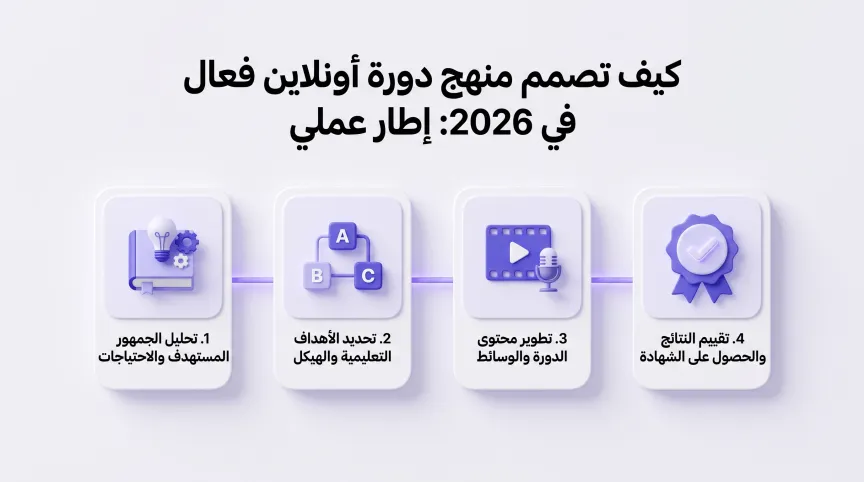
A well-designed curriculum does three things: it breaks a complex topic into a logical learning path, it maintains momentum through variety and progressive challenge, and it proves to students at every stage that they are making measurable progress. This guide gives you a practical framework for designing a curriculum that delivers results.
Short answer
Start With the Transformation, Not the Topics
Before you outline a single module, define the specific transformation your course delivers. What will a student be able to do after completing your course that they cannot do today? Write this as a clear, concrete statement. Every piece of content in your course should directly serve this transformation. Anything that does not contribute gets cut — no matter how interesting it might be.
Work backwards from the transformation. Identify the three to five key skills or knowledge areas a student must master to achieve the outcome. These become your core modules. Within each module, list the specific sub-skills or concepts students need to learn. These become your individual lessons.
Structure Your Modules for Progressive Learning
Arrange your modules in a logical sequence where each one builds on the previous. Early modules should establish foundational knowledge and quick wins that build confidence. Middle modules tackle the core skills with increasing complexity. Final modules focus on application, synthesis, and real-world practice.
Keep your total course between four and eight modules. Research consistently shows that courses with fewer, more focused modules have higher completion rates than sprawling courses with fifteen or twenty sections. On TRAIVIS, the five-step Course Workshop guides you through building this structure using an intuitive drag-and-drop interface.
Design Lessons That Respect Attention Spans
Each lesson should teach one concept or skill and be five to fifteen minutes long. This is not arbitrary — attention research confirms that engagement drops sharply after fifteen minutes of continuous video content. Shorter lessons also let students fit learning into busy schedules and create natural stopping points that reduce abandonment.
Vary your lesson formats. Alternate between video lectures, screen recordings, demonstrations, case studies, and hands-on exercises. This variety prevents monotony and accommodates different learning styles. End each lesson with a clear action item or reflection prompt so students immediately apply what they have learned.
Build Assessments That Reinforce, Not Just Test
Assessments should be learning tools, not just evaluation tools. Place a short quiz at the end of each module to help students consolidate their knowledge. Use a mix of question types: multiple-choice for factual recall and open-ended questions for deeper analysis and application.
A flexible grading system — combining automated quizzes for instant feedback with manually graded assignments for personalised feedback — gives students the best learning experience. On TRAIVIS, instructors can design both types, and the platform automatically tracks progress and issues a verifiable certificate when a student reaches full completion.
Use AI to Accelerate Curriculum Planning
Artificial intelligence has become a powerful ally for curriculum design. Instead of staring at a blank page, you can use AI tools to generate a complete course outline — section names, lecture titles, course name, and description — from a topic prompt. This gives you a strong starting framework that you can refine with your expertise.
On TRAIVIS, the AI Course Builder does exactly this. You specify the number of sections, the number of lectures per section, and your topic. The AI generates a full curriculum outline that you can review, modify, and publish directly into the Course Workshop. This saves hours of planning time and ensures your structure follows proven instructional design patterns.
Map Your Curriculum to Student Milestones
Students need to feel progress at regular intervals. Design your curriculum with explicit milestones — moments where students can see how far they have come and what they have achieved. These might be completing a module, finishing a project, passing an assessment, or earning a badge.
On TRAIVIS, automated progress tracking shows students their completion percentage in real time. When they reach one hundred percent attendance and pass all assessments, the platform automatically issues a certificate — a tangible milestone that validates their effort and adds credibility to their professional profile.
Test Your Curriculum Before You Record
Before investing time in video production, validate your curriculum structure. Share the outline with a few people in your target audience and ask whether the learning path makes sense, whether any topics feel missing or unnecessary, and whether the scope feels achievable. Run a pilot with a small group of beta students who go through the course live and provide feedback on each module.