
Best Platform for Arabic Online Courses in 2026: What Actually Matters
This guide breaks down the capabilities that genuinely matter when choosing a course platform for Arabic-speaking audiences — and where the major options stand in 2026.
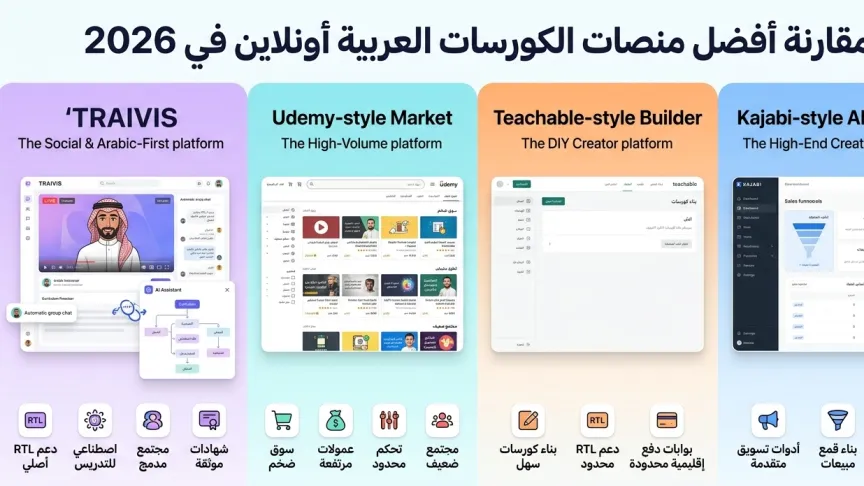
Short answer
Why Arabic Instructors Need More Than a Translated Interface
A platform that simply translates its English menu into Arabic is not an Arabic-first platform. True Arabic support means the entire experience — navigation, course pages, notifications, certificates, and community features — works seamlessly in a right-to-left layout. It means payment gateways that support regional payment methods and currencies used across the Arab world. And it means a discovery engine that surfaces Arabic courses to Arabic-speaking learners without burying them under English-language results.
Quality Arabic educational content is still in its early stages online. While the internet penetration among Arabic speakers is significant, the supply of well-structured, professionally produced Arabic courses has not kept pace with demand. This gap represents a massive opportunity for instructors who move early and choose the right platform.
The Seven Capabilities That Matter Most
1. Native Language and RTL Support
The platform interface should support Arabic natively — not as a bolted-on translation but as a first-class language option. This includes right-to-left text rendering in course content, social feeds, messaging, and certificates. Look for platforms that let you toggle between Arabic and English seamlessly. TRAIVIS, for example, offers full platform preferences including language and theme switching, and its unified profile system works across both languages from a single account.
2. Payment Processing for the Arab Market
Many global platforms process payments only in US dollars, which creates friction for both instructors and students in the MENA region. The ideal platform supports secure payment processing through gateways familiar to the region, with the ability to display prices in local currencies even if the backend processing happens in a stable base currency. TRAIVIS processes all transactions securely in British Pounds while allowing users to toggle a display currency to view prices in their local currency — combining stability for instructors with familiarity for buyers.
3. Built-in Social and Community Features
Arab learners value community and personal connection with their instructors far more than the average global benchmark suggests. A platform that isolates students inside a video player is leaving enormous value on the table. Look for social feeds where instructors can post updates and engage followers, course group chats where students can discuss lessons and network, broadcast tools for mass announcements, and messaging systems for one-on-one communication.
TRAIVIS was built around this social-first philosophy. Every published course generates an automatic group chat. Instructors have a social feed, broadcast tools, and a follower system — turning the platform into a professional learning community rather than just a content library.
4. AI-Powered Tools for Instructors and Learners
AI has moved from a novelty to a necessity in e-learning platforms. For instructors, AI should help with course creation — generating outlines, suggesting curriculum structures, and automating repetitive tasks like welcome messages and follow-up emails. For learners, AI should enhance the study experience through personalised recommendations, skill gap analysis, and on-demand tutoring within the course.
TRAIVIS integrates AI deeply on both sides. Its AI Assistant helps students review courses before purchasing, provides in-course tutoring, and generates quizzes. For instructors, the AI Course Builder creates complete course outlines from a topic prompt, and the AI Automation engine lets instructors build trigger-action workflows — like automatically sending a personalised welcome when a student enrols — using smart template variables.
5. Course Quality and Certification
Verifiable certificates matter enormously in the Arab job market, where proof of professional development can directly impact hiring and promotion decisions. The platform should offer automated certificate issuance tied to actual course completion and assessment scores, and ideally a public verification system where employers can confirm a certificate is genuine using a unique ID — eliminating the risk of image forgery.
6. Instructor Control and Marketing Tools
Arabic instructors need full control over their courses, pricing, and marketing. This means the ability to set prices, create discount coupons, access detailed analytics about student behaviour and revenue, and manage their own audience through follower lists and broadcast tools. Platforms that restrict instructor control — like marketplaces that dictate pricing or take heavy commissions — limit an instructor's ability to build a sustainable teaching business.
7. Financial Transparency and Instructor Protection
Trust in the financial system is non-negotiable. Instructors need to see exactly where their money is at every stage — from sale to available balance to bank withdrawal. A transparent wallet system with clear hold periods that align with refund policies protects both instructors and students. TRAIVIS uses a 14-day hold system: all course sales sit in the instructor's wallet for exactly 14 days (matching the refund window), then move to the available balance for withdrawal. This protects student investments while giving instructors complete visibility into their earnings.
How the Major Platforms Compare for Arabic Instructors
Udemy offers a massive marketplace with some Arabic courses, but instructors have limited control over pricing and the platform takes a significant commission on marketplace-driven sales. The interface has Arabic translation but is not Arabic-first. Social features and community tools are minimal.
Teachable and Kajabi are strong for English-speaking creators who want to build branded course websites, but their Arabic language support, RTL rendering, and regional payment capabilities are limited. They offer no built-in social networking or community features — you need external tools for that.
Coursera partners with universities and focuses on accredited programs. Individual instructors cannot simply open an account and start teaching. Arabic content exists but is curated by institutional partners rather than independent creators.
TRAIVIS is purpose-built as a social e-learning ecosystem with a unified profile system, native language support, AI-powered course creation and automation, built-in social networking, transparent GBP financial processing with a display currency toggle, verifiable certificates, and a gamification system that rewards engagement. It is designed for instructors who want to build both a course business and a professional learning community from a single platform.